

The narrative around college costs has become predictable: tuition keeps rising, student debt is mounting, and higher education is becoming increasingly unaffordable. However, a careful analysis of recent pricing data reveals a more nuanced story 鈥� one that challenges these common assumptions and highlights the importance of distinguishing between sticker price and net price when evaluating college costs.
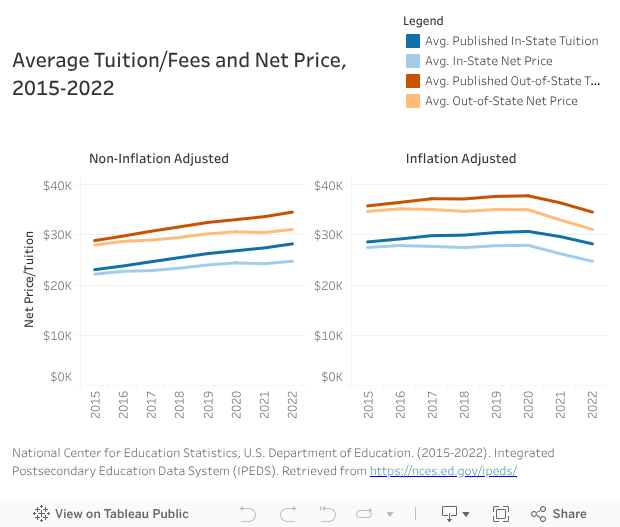
As shown in the graph above, while nominal tuition and fees have indeed continued to rise between 2015 and 2022, the inflation-adjusted figures tell a different story. When accounting for inflation, both public and private institution prices have shown notable moderation, with some sectors even experiencing real declines in recent years.
Understanding the Public-Private Divide
The divergence between public and private institutions’ pricing strategies has become increasingly pronounced, particularly when examining institutions by selectivity tier.
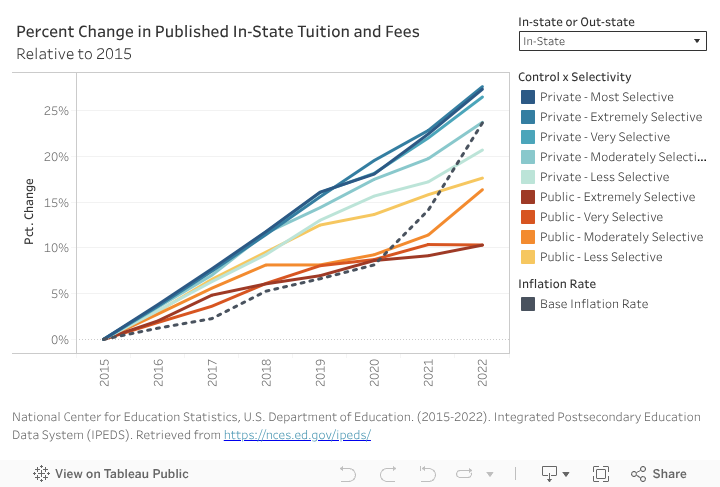
Private institutions, especially the most selective ones, have continued to raise their published tuition at rates exceeding inflation. However, this trend masks a crucial detail about actual student costs, as we’ll explore when examining net prices.
Consider two contrasting examples: Rochester Institute of Technology has increased its tuition by 20% since 2015 (inflation-adjusted), while Georgia Tech’s in-state tuition has decreased by approximately 22% during the same period. These divergent approaches reflect fundamentally different market positions and funding models. Georgia Tech’s pricing strategy likely reflects both state policy decisions and a commitment to accessibility for in-state students. Meanwhile, RIT’s approach suggests a market positioning strategy typical of private institutions, though importantly, its net price has grown by only 12% relative to inflation 鈥� substantially less than its headline tuition increase.
The Net Price Reality
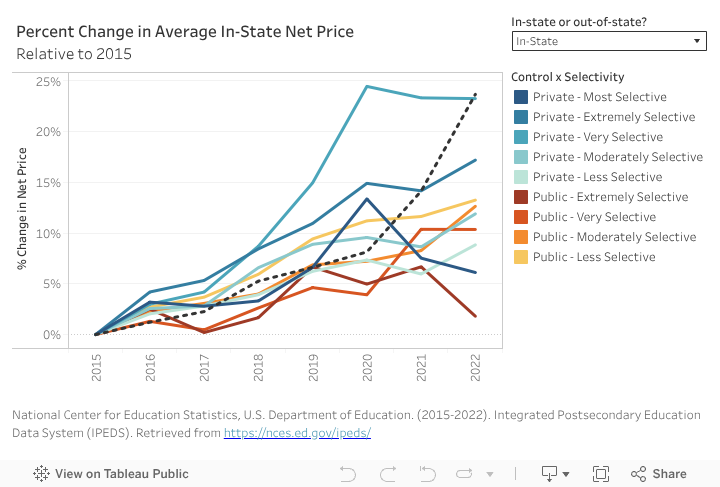
When examining net price 鈥� calculated as tuition plus room/board, books, fees, and other expenses, minus average grants and scholarships 鈥� a different pattern emerges. Most selective private institutions, despite showing the highest published tuition increases, have maintained relatively stable net prices. This paradox reflects aggressive tuition discounting strategies and robust institutional aid programs, particularly at wealthy private institutions with substantial endowments.
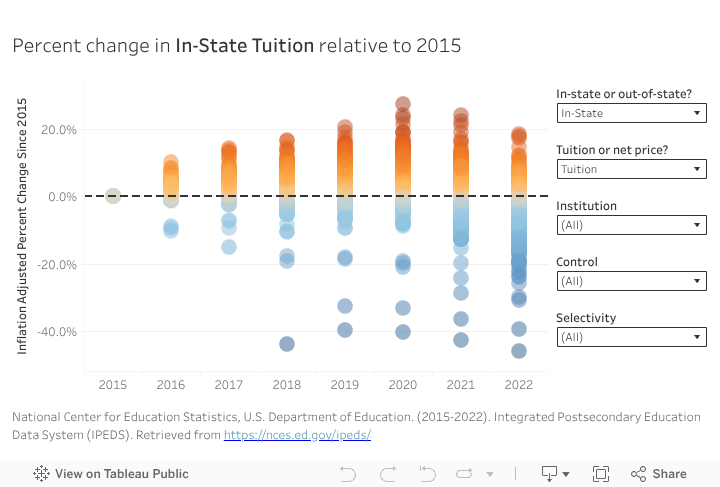
The variation in institutional responses to pricing pressures has grown significantly in recent years, as illustrated by the spreading distribution of points in our final visualization. This divergence suggests that institutions are increasingly pursuing individualized pricing strategies based on their specific market positions, resource bases, and strategic objectives.
We encourage readers to interact with this visualization to uncover their own insights. By toggling between tuition and net price, you can observe how different institutions approach pricing and financial aid. Try selecting specific institutions to track their trajectory over time, or filter by institutional control and selectivity to identify patterns within peer groups. This interactive exploration reveals fascinating stories: some institutions maintaining stable pricing in real terms, others pursuing aggressive increases, and still others reducing their real costs to students. The variation in approaches has grown significantly in recent years, as illustrated by the widening distribution of points, suggesting that institutions are increasingly pursuing individualized pricing strategies based on their specific market positions, resource bases, and strategic objectives.
The Out-of-State Revenue Factor
For public institutions, out-of-state enrollment has become an increasingly important revenue strategy. While in-state tuition growth has moderated, out-of-state prices have continued to rise as public institutions seek to diversify their revenue streams. This trend anticipates our next discussion about institutional revenue sources, where we’ll examine how the composition of college and university funding has evolved over time.
Looking Beyond Sticker Price
The recent high-inflation environment has made the distinction between nominal and real prices particularly relevant. While nominal tuition continues to rise at most institutions, real (inflation-adjusted) prices have actually declined in many cases since 2020, reflecting widespread tuition freezes and mounting pressure to control costs.
This reality underscores the importance of looking beyond headlines about rising tuition. Net price, rather than published tuition, provides a more accurate picture of actual student costs. However, even this metric has limitations, as it represents an average that may not reflect individual student experiences.
Looking Ahead
This analysis of pricing trends sets the stage for our deeper exploration of higher education finance. In our next installment, we’ll examine how different types of institutions derive their operating revenue, including the varying importance of tuition dollars across institutional types. This will be followed by an analysis of expenditure patterns, providing a comprehensive view of the financial dynamics shaping American higher education.
The story of college pricing is more complex than often portrayed. While affordability remains a crucial concern, understanding the nuances of pricing trends 鈥� particularly the distinction between sticker price and net price 鈥� is essential for meaningful discussions about college costs and institutional financial strategies.

