

The management consulting industry continues to attract top talent with its compelling combination of intellectual challenge, rapid professional development, and attractive compensation packages. For recent graduates, the industry offers particularly appealing prospects, with entry-level consultants at top firms often commanding base salaries exceeding $90,000 and total compensation packages potentially reaching six figures. Career progression can be rapid, with opportunities for significant responsibility and client exposure within the first few years.
Through analysis of LinkedIn data from recent graduates (2015-onwards) with fewer than five years of experience at leading firms including McKinsey, Bain, BCG, and other prestigious consultancies, we’ve identified clear patterns in hiring practices and institutional pipelines. This analysis offers valuable insights for students considering consulting careers and the counselors who guide them.
Methodology:
Our analysis examines employment data from LinkedIn, focusing on recent graduates who have entered the consulting industry. To ensure data accuracy and relevance, we applied the following criteria:
- Employment Scope: Analysis was limited to U.S.-based employees working at 13 identified consulting firms: Analysis Group, Accenture, McKinsey & Company, Boston Consulting Group, Oliver Wyman, Bain & Company, Alvarez & Marsal, Deloitte, EY/EY-Parthenon, L.E.K. Consulting, Strategy&, PwC, or KPMG
- Position Requirements: Only employees with current job titles of: Analyst, Business Analyst, Associate, Consultant
- Time Frame: Graduates from 2015-onwards with fewer than 5 years of experience
Key Findings and Analysis:
Dominance of Elite Private Institutions
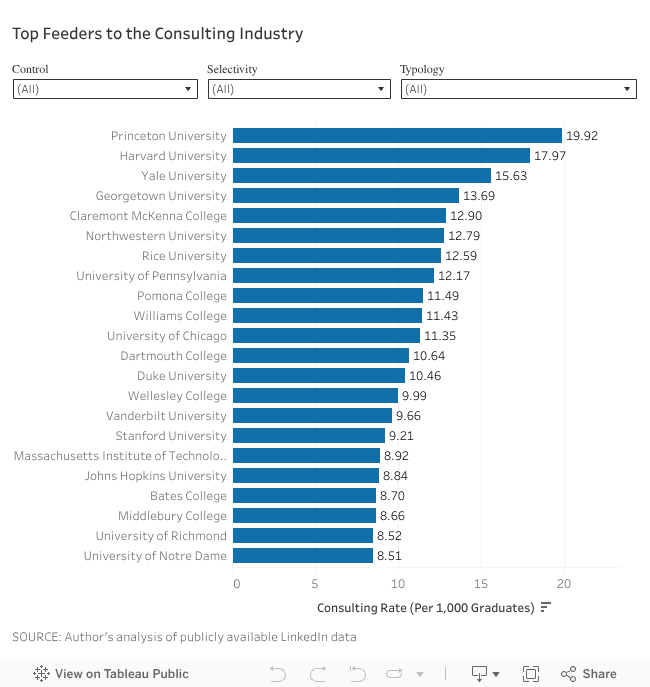
The data reveals a striking concentration of consulting recruitment at prestigious private institutions. Princeton University leads the pack with approximately 20 consultants per 1,000 graduates, followed closely by Harvard University (18 per 1,000) and Yale University (16 per 1,000). This Ivy League dominance extends beyond the top three, with multiple Ivy institutions appearing among the top feeders.
What sets these institutions apart isn鈥檛 merely their brand recognition. These universities have developed robust career services infrastructure specifically tailored to consulting recruitment, including case interview preparation programs, alumni mentorship networks, and strong relationships with major consulting firms. Princeton’s exceptional placement rate, for instance, likely stems from its combination of rigorous analytical training and well-established recruiting partnerships with top consulting firms.
The Selectivity Factor
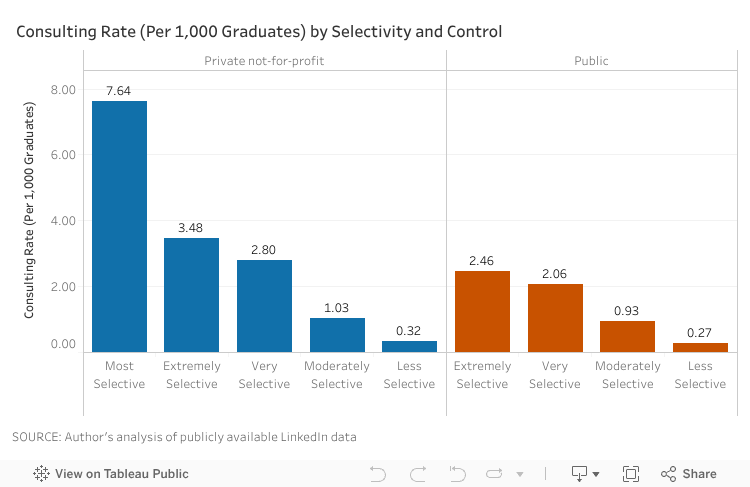
Our analysis reveals a clear correlation between institutional selectivity and consulting placement rates. Among private not-for-profit institutions, the most selective schools place about 7.64 graduates per 1,000 into consulting roles, while extremely selective institutions place 3.48 per 1,000. This pattern holds true across both private and public institutions, though with different magnitudes.
Alternative Pathways
While the data demonstrates the advantages of attending highly selective private institutions, it’s crucial to note that multiple pathways into consulting exist. Public universities, particularly their flagship programs, continue to place graduates into prestigious consulting roles. The data shows that extremely selective public institutions achieve placement rates of 2.46 per 1,000 graduates 鈥� a meaningful pipeline that shouldn’t be overlooked.
Additionally, an interesting pattern emerges in the strong showing of elite liberal arts colleges, with Claremont McKenna College, Pomona College, and Williams College all placing among the top feeders. This success suggests that the analytical thinking, writing, and problem-solving skills emphasized in liberal arts education align well with consulting firms’ requirements.
Implications for Students:
The data underscores the importance of institutional choice in consulting career prospects. Students should consider not just overall institutional prestige but specific factors like career services resources and consulting recruitment history.
In addition, the strong correlation between institutional selectivity and placement rates suggests that academic excellence remains crucial. Students should focus on maintaining strong academic performance regardless of their institution.
Lastly, the success of liberal arts colleges highlights the importance of developing broad analytical and communication skills alongside any technical expertise.
Conclusion:
While the path to consulting careers shows clear advantages for students at elite private institutions, success stories emerge from a broader range of schools. The key for students and counselors is understanding these patterns while recognizing that individual preparation, skill development, and networking can help navigate alternative routes into the industry. As consulting firms face increasing pressure to diversify their talent pools, we may see evolving recruitment patterns in the coming years.
For students and counselors seeking more information about consulting careers, we recommend exploring:
- Individual firm websites for specific recruitment criteria and programs
- Campus career services offices for institution-specific recruitment data
- Professional organizations focused on consulting careers
- LinkedIn profiles of current consultants from target institutions

