For aspiring doctors, the journey to medical school is often viewed as a challenging and competitive process. While excellent grades and strong MCAT scores are certainly crucial, the role of one鈥檚 undergraduate institution in shaping this path is a topic of great interest to students, parents, and educators alike. In this post, we present an analysis of the top feeder schools to medical programs, offering insights based on a vast dataset of over 7.7 million college graduates since 2005 collected from LinkedIn, a professional networking site featuring profiles of approximately 170 million workers across the United States.
The Power of Undergraduate Institutions
Our analysis begins with a look at the top feeders to medical schools across the United States. The data reveals a clear trend: prestigious universities dominate the list of institutions sending the highest percentage of their graduates to medical schools.
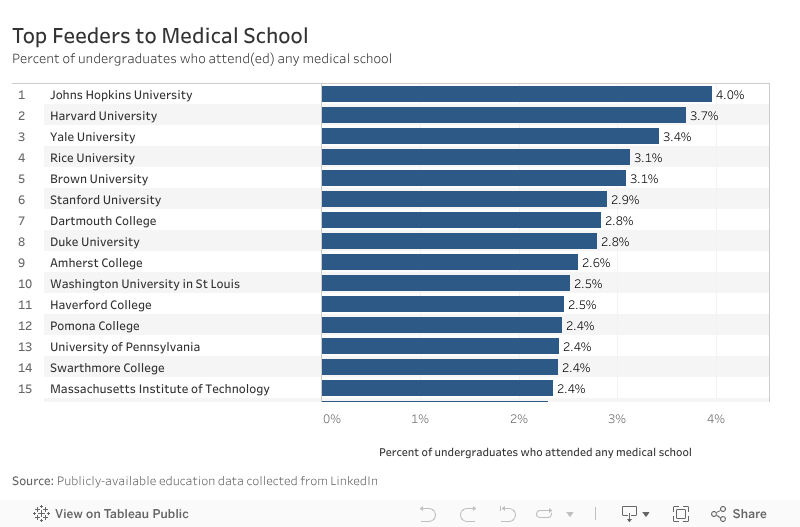
As shown in the visualization, Johns Hopkins University leads the pack, with an impressive 4% of their graduates going on to attend medical school. They are closely followed by Harvard (3.7%), Yale University (3.4%), and Rice University (3.1%). This data suggests that attending a highly selective undergraduate institution may provide a significant advantage in the medical school admissions process.
However, it’s important to note that these percentages represent overall medical school attendance. When we narrow our focus to top medical schools, the landscape shifts slightly:
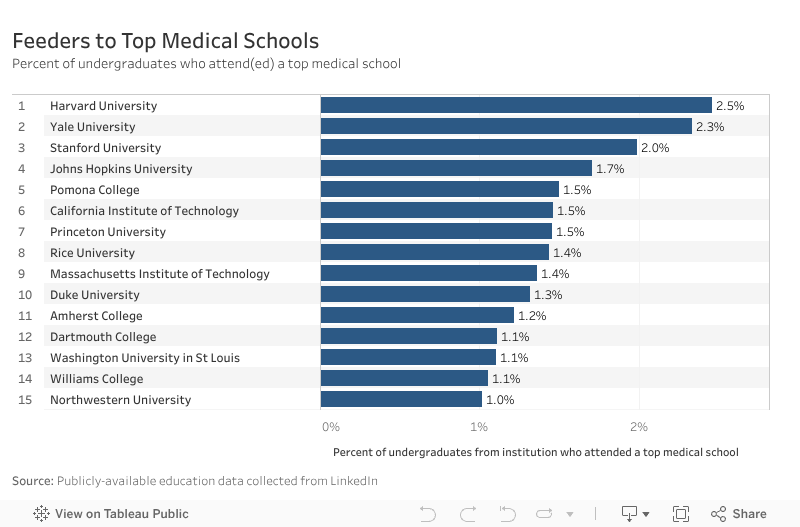
Harvard takes the lead at 2.5%, followed closely by Yale at 2.3%. This indicates that while prestigious universities are strong feeders to medical schools in general, their impact is even more pronounced when it comes to the most competitive medical programs.
Note: For the purpose of this analysis, we define top med schools as the following: Harvard University, Johns Hopkins University, University of Pennsylvania (Perelman), New York University (Grossman), Stanford University, Columbia University, Mayo Clinic School of Medicine, UCLA (Geffen), University of California-San Francisco, Washington University, Cornell University (Weill), Duke University, University of Washington, University of Pittsburgh, University of Michigan, Yale University, University of Chicago (Pritzker), Northwestern University (Feinberg), Vanderbilt University, Icahn School of Medicine at Mount Sinai, University of California at San Diego, Baylor College of Medicine, University of North Carolina at Chapel Hill, Case Western Reserve University, and Emory University.
The Liberal Arts Advantage?
Interestingly, when we examine the data more closely, we see that liberal arts colleges also play a significant role in feeding students into medical schools:
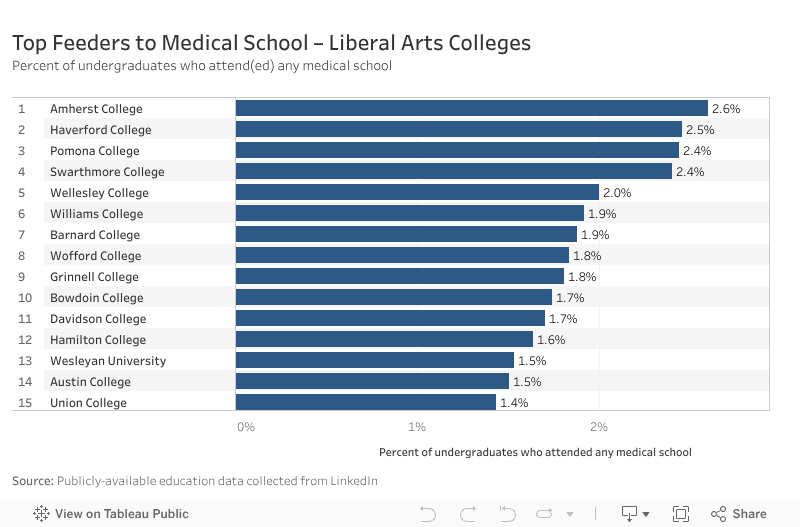
Amherst College, for instance, sends 2.6% of its graduates to medical school, followed by Haverford at 2.5%. This suggests that small, selective liberal arts colleges are also powerful launchpads for medical careers, possibly due to their focus on critical thinking, writing skills, and close student-faculty interactions.
The Selectivity Factor
To further understand the relationship between undergraduate selectivity and medical school admission, we turn to a broader analysis of selectivity bands:
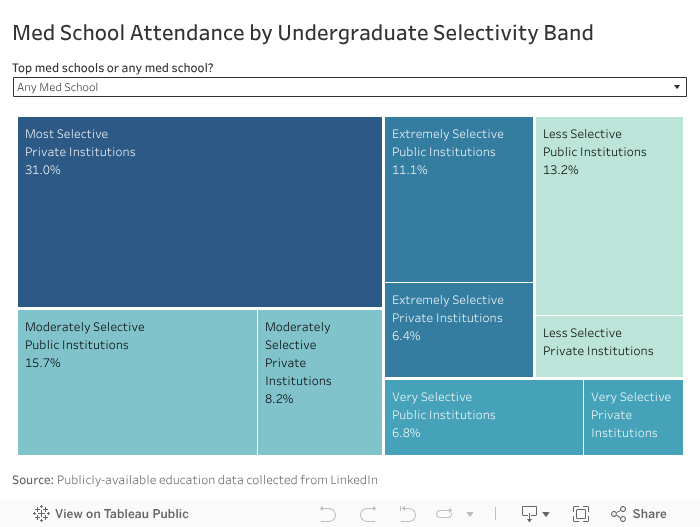
This visualization strikingly illustrates that the most selective private institutions send the highest proportion of students to medical school, followed by extremely selective public institutions. This trend holds true even if we focus solely on top medical schools, where the disparity becomes even more pronounced 鈥� over 53% of medical students in the top programs came from a top-tier undergraduate education.
From Undergraduate to Medical School: Institutional Pipelines
While these broad trends are informative, it鈥檚 also valuable to examine specific pathways from undergraduate institutions to medical schools. This visualization allows us to explore where students from a selected undergraduate institution end up attending medical school:
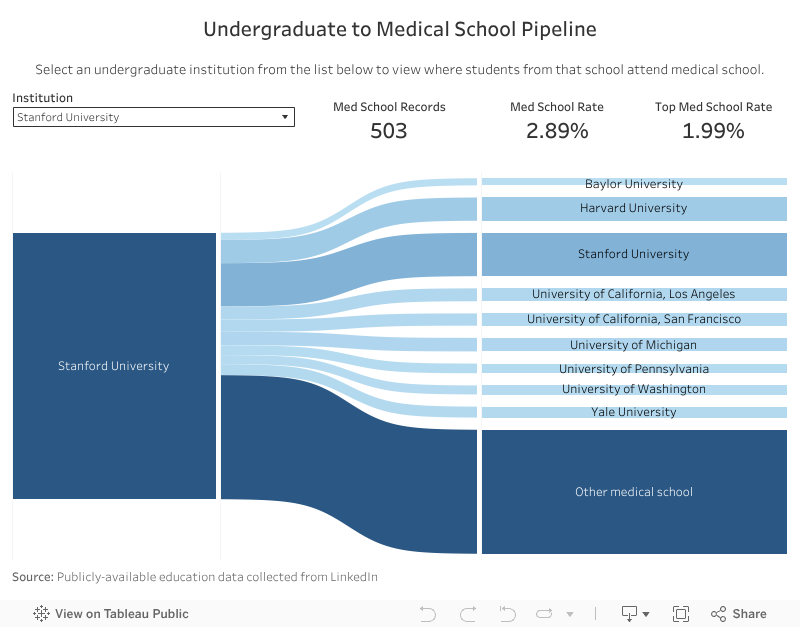
Stanford University, for example, sends its pre-med graduates to a diverse array of top medical schools, including its own program, Harvard, UCLA, and UCSF. This kind of data can be invaluable for prospective students planning their educational journey.
The Medical School Perspective: Where Do Students Come From?
Equally interesting is the view from the medical school perspective. Selecting Baylor University鈥檚 medical school, for instance, reveals a strong regional draw, with many students coming from Texas institutions like Rice University, the University of Texas at Austin, and Texas A&M:
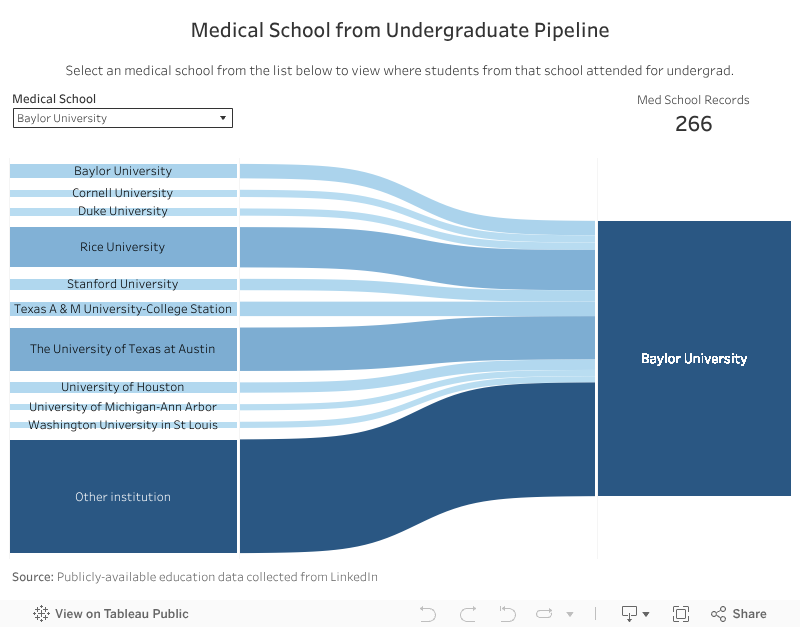
This information could be particularly useful for students with a specific medical school in mind, helping them understand which undergraduate institutions might best position them for admission. The strong regional pattern we see with Baylor is common among many medical schools, especially public institutions. This trend likely reflects a combination of factors, including state residency preferences in admissions, the tendency of students to apply to nearby schools, and the strength of established pipelines between certain undergraduate and medical programs.
It’s worth noting that even for a school like Baylor, which shows a strong regional draw, there鈥檚 still significant diversity in the undergraduate institutions represented. This suggests that while attending a nearby or affiliated undergraduate institution may provide an advantage, it鈥檚 certainly not the only path into the medical school of your choosing.
Implications and Conclusions
This data paints a complex picture of the journey to medical school. While attending a prestigious or highly selective undergraduate institution appears to offer significant advantages in medical school admissions, it鈥檚 clear that this is not the only path. Liberal arts colleges and top public universities also serve as strong feeders to medical programs. However, it’s important to understand a key limitation of this data: it only shows students who actually attended medical school, not everyone who got in.
For students aspiring to medical careers, this information can be valuable in shaping their college choices. However, it鈥檚 crucial to remember that individual factors such as GPA, MCAT scores, research experience, and extracurricular activities play vital roles in the admissions process.
As we continue to analyze and understand these trends, it鈥檚 clear that the path to medical school is complex. While the prestige of one鈥檚 undergraduate institution can open doors, ultimately, it is the individual student鈥檚 dedication, academic performance, and passion for medicine that will determine their success in pursuing a medical career.
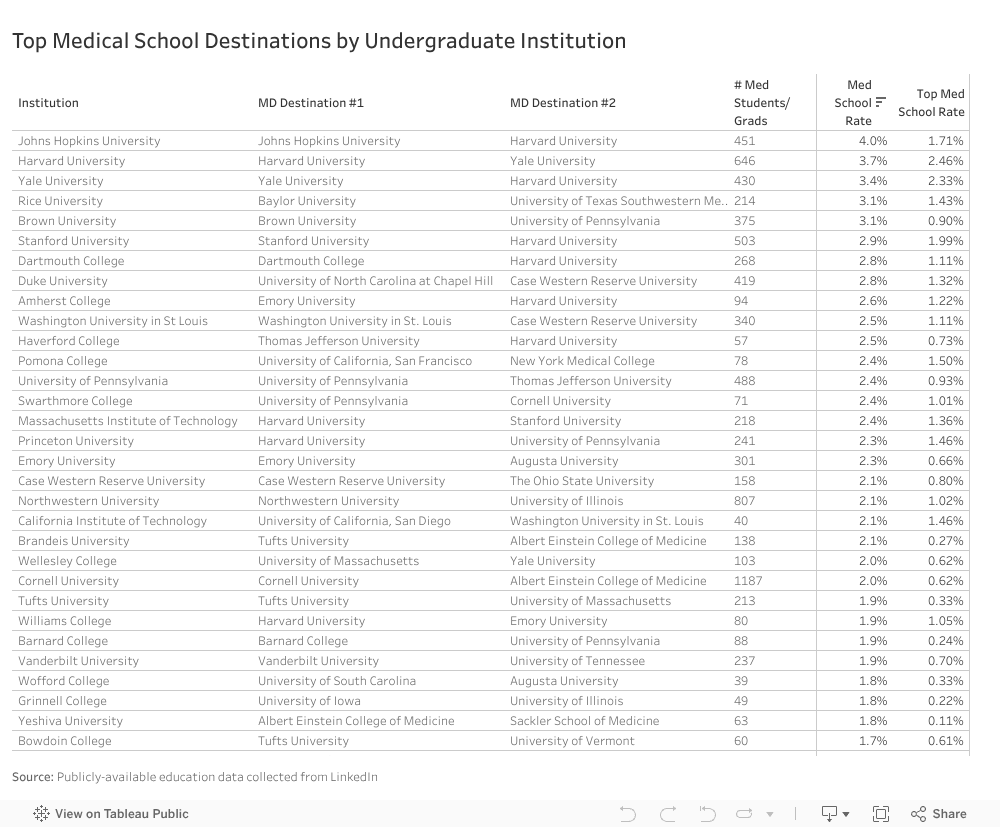
We encourage readers to explore the interactive visualizations provided to gain deeper insights into the patterns and trends in medical school pipelines. By adjusting the filters and examining different institutions, you can uncover valuable information about specific pathways to M.D. degrees. For those interested in a more detailed breakdown of the data, we’ve included a comprehensive table below, allowing for easy comparison across institutions and offers a wealth of information for students, parents, and educators alike. Whether you鈥檙e interested in the broader trends of medical school pipelines or the specific pathways for particular undergraduate institutions, these visualizations offer a wealth of data to inform your understanding of the medical school landscape.