

Introduction
In our previous analysis of college pricing trends, we explored how the story of college costs is more nuanced than often portrayed, particularly when distinguishing between sticker price and net price. Now, we turn our attention to an equally complex aspect of higher education finance: how colleges and universities fund their operations. Understanding institutional revenue sources provides crucial context for discussions about college costs, access, and sustainability.
At first glance, the aggregate trends in higher education revenue appear relatively stable. Tuition and fees, while significant, have actually declined as a share of total operating revenue 鈥� from 38% in 2010 to 32% in 2022. However, this high-level view masks substantial variation across institutions. We encourage readers to explore this interactive visualization by selecting specific institutions of interest. For instance, examining individual institutions reveals dramatically different funding models.
Consider two contrasting examples from Georgia: Emory University and the University of Georgia (UGA). Emory’s revenue structure is dominated by sales and services (approximately 80% of operating revenue), reflecting its extensive healthcare system. In contrast, UGA shows a more diversified revenue portfolio, with tuition accounting for roughly 40% of revenue, complemented by significant state support and growing federal funding.
The Impact of External Events: COVID-19 and Federal Support聽
The pandemic’s impact on higher education finances is evident in our data, particularly in the surge of federal support through the Higher Education Emergency Relief Fund (HEERF). This appears as an increase in federal operating grants and contracts starting in 2020. However, the magnitude of this impact varied significantly by institution type and existing revenue mix.
Public-Private Divide: Different Models, Different Challenges
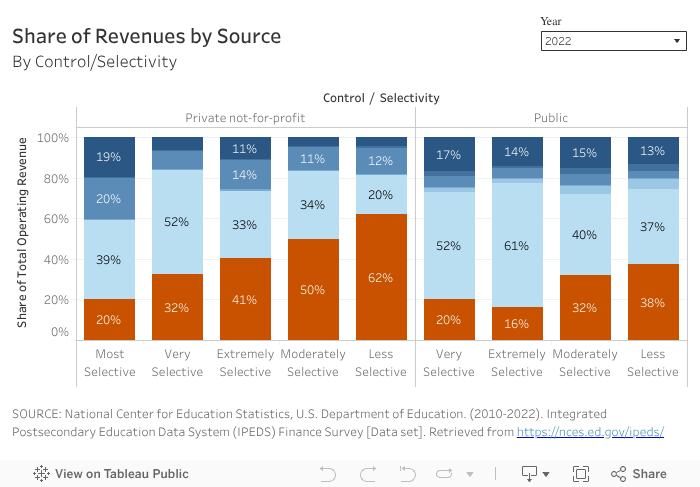
The distinction between public and private institutions reveals fundamentally different approaches to revenue generation. Less selective private institutions show the highest dependency on tuition (62% of operating revenue), while elite private institutions demonstrate much lower tuition dependency (20% for the most selective). This pattern reflects several factors:
- Endowment Resources: More selective private institutions often have substantial endowments, generating significant private grants and investment income.
- Research Funding: Selective institutions, both public and private, typically attract more federal research funding.
- Auxiliary Enterprises: Many institutions, particularly research universities and those with medical centers, generate substantial revenue through auxiliary services.
The Selectivity Factor聽
Our analysis reveals a clear correlation between institutional selectivity and revenue diversification. The most selective institutions 鈥� both public and private 鈥� generally show lower tuition dependency and more diverse revenue streams. This pattern has important implications:
- Financial Resilience: Diverse revenue streams can provide stability during economic downturns or enrollment fluctuations.
- Pricing Flexibility: Less tuition-dependent institutions may have more flexibility in their pricing and financial aid strategies.
- Strategic Opportunities: Institutions with diverse revenue sources may be better positioned to invest in new initiatives or weather challenges.
The Liberal Arts Perspective聽
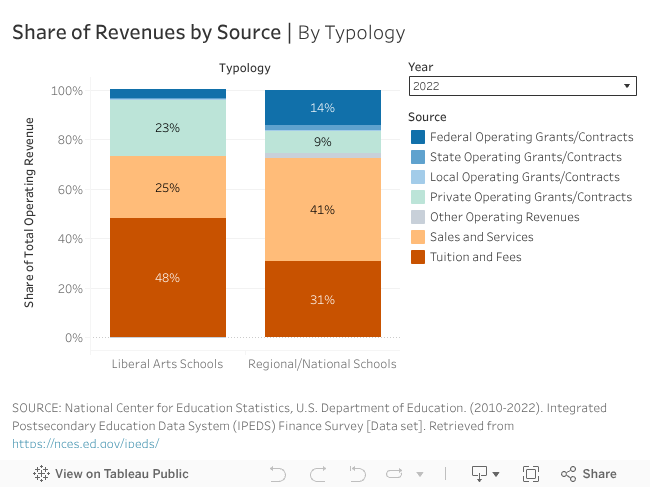
Looking specifically at institutional typology reveals another interesting pattern. Liberal arts colleges show significantly higher tuition dependency (48%) compared to regional/national universities (31%). This difference reflects both mission and scale 鈥� liberal arts colleges typically focus on undergraduate education and lack the large research operations or medical centers that often generate substantial revenue for larger universities.
Interactive Exploration聽
We encourage readers to explore these visualizations in detail. The ability to filter by institution provides fascinating insights into different financial models:
- Selective Research Universities: Often show substantial federal grant funding and sales/service revenue
- Regional Public Universities: Typically demonstrate higher tuition dependency and state support
- Liberal Arts Colleges: Generally show higher tuition dependency but often significant private grant support
- Public Flagships: Usually display diverse revenue streams including state support, research funding, and auxiliary services
Looking Ahead聽
This analysis of revenue patterns sets the stage for our next exploration: institutional expenditures. Understanding how different revenue models influence spending priorities 鈥� and vice versa 鈥� is crucial for comprehending the financial dynamics of higher education. We’ll examine questions such as:
- How do institutions with different revenue models allocate their resources?
- What is the relationship between control, selectivity, typology, and spending priorities?
Key Takeaways:
- Revenue diversification varies significantly by institutional type and selectivity
- The traditional narrative of tuition dependency needs nuancing 鈥� many institutions rely heavily on other revenue streams
- External events like COVID-19 can significantly impact institutional finances, though effects vary by institution type
- Understanding revenue patterns is crucial for evaluating institutional stability and strategy
As we continue our series on higher education finance, these insights about revenue sources will provide essential context for understanding how institutions allocate their resources and set their priorities. Look for our next installment, where we’ll examine expenditure patterns across different types of institutions.

