

Navigating the financial aid landscape when choosing a college can be daunting, especially when trying to understand the different types of aid available and how they are awarded. Merit-based aid and need-based grants are two common forms of financial assistance, but their distribution varies widely based on selectivity, control, and tuition costs.
What is the difference between need-based vs. merit-based aid?
Need-based aid is awarded based on a student鈥檚 demonstrated financial need, which is determined by factors such as family income, assets, and household size. This type of aid includes grants, scholarships, and work-study programs that help bridge the gap between the cost of attendance and a student鈥檚 expected family contribution.
On the other hand, merit aid (also known as non-need-based aid), is awarded based on a student鈥檚 academic achievements, talents, or other qualifications, regardless of their financial need. Merit aid can include scholarships, grants, and tuition waivers that recognize a student鈥檚 personal accomplishments.聽
Looking at the data, we can see some clear trends in both how need-based and merit-based aid are distributed across colleges with different tuition costs and selectivity levels. First, let鈥檚 examine need-based aid.
Need-Based Grants across the Tuition and Selectivity Spectrum
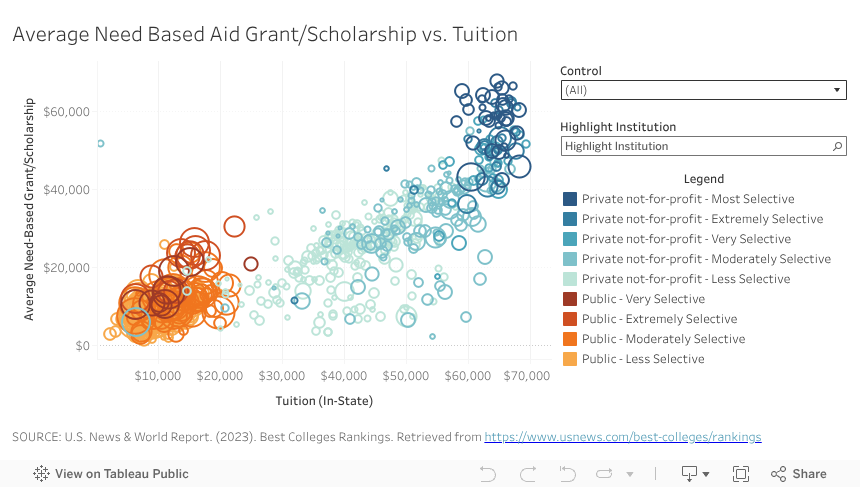
In general, the amount of need-based aid increases with tuition. The most selective private colleges, which also have the highest tuitions upwards of $65,000, tend to provide the most generous need-based packages, averaging over $50,000 per year. Meanwhile, lesser selective private institutions have smaller average need-based grants. Public colleges across at all selectivity levels cluster at the lower end for both tuition and average need-based aid. You may type in the institution of your choice under 鈥淗ighlight institution鈥� to see where any particular falls across this distribution.
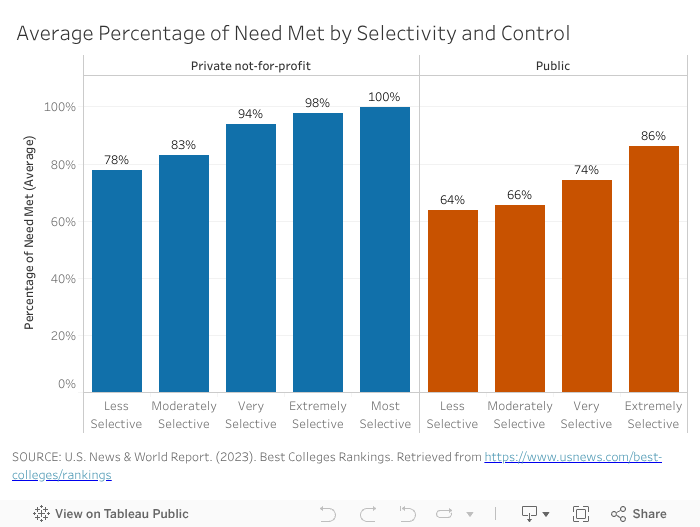
When looking at the percentage of need met, the most selective and extremely selective private colleges meet nearly 100% of demonstrated need, while less selective private colleges and public colleges meet a lower percentage of need depending on selectivity. While the most selective private colleges charge the highest tuition, they also tend to offer the most generous need-based aid to make it possible for students from lower backgrounds to attend.
Merit-Based Scholarships across the Tuition and Selectivity Spectrum
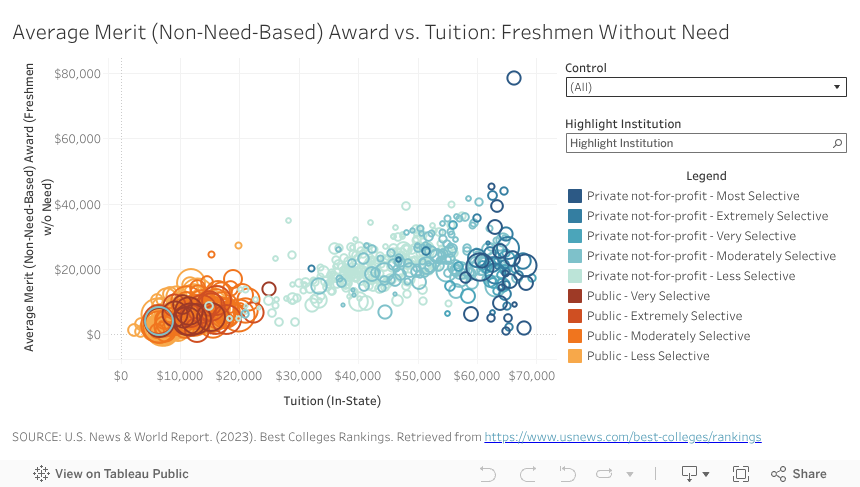
Turning to merit aid, which is not based on financial need, we see a somewhat different pattern. The scatterplot above shows that there is a wide range of the average merit award across all tuition levels for students without demonstrated financial need. In fact, many of the most selective private colleges with the highest tuitions offer little to no merit aid. The colleges providing the highest average merit awards, sometimes exceeding $30,000, tend to be colleges outside of the 鈥渕ost selective鈥� sector, perhaps using merit aid to attract high-achieving students. Public colleges at all levels provide much lower merit aid awards on average.
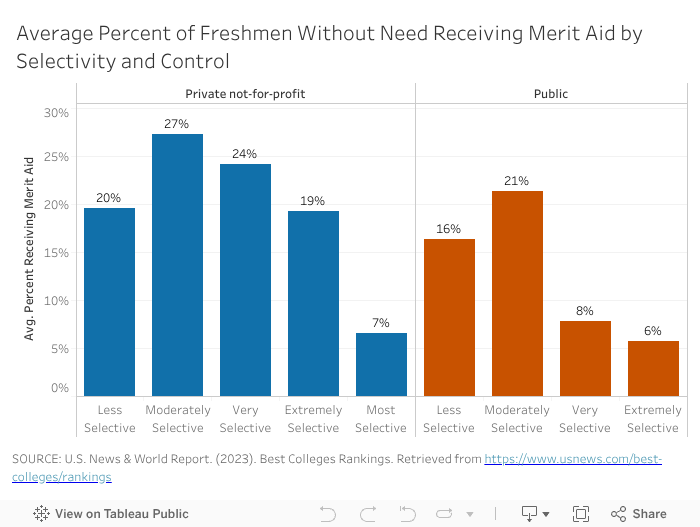
This is further illustrated above, where we look at the average percent of freshmen without need receiving merit aid, by selectivity and control. Moderately selective colleges across both public and private sectors tend to offer merit-based aid more frequently, while the most selective colleges may rely more on need-based aid to attract students.
Conclusion
In summary, the most selective colleges tend to focus their financial aid resources on meeting full need for lower-income students, while lesser-selective private colleges are more likely to utilize merit aid to recruit students from higher income levels. In addition, public colleges provide much less aid overall, especially merit aid. Students seeking generous need-based aid may want to target the highly selective private colleges, while those looking for merit scholarships are more likely to find them in moderately selective colleges.

