

In today鈥檚 competitive job market and evolving economic landscape, understanding the return on investment (ROI) of a college education has become increasingly crucial for students, parents, and policymakers alike. At 国产第一福利影院草草, we recognize the complexity of this topic and aim to provide a comprehensive analysis of how various institutional characteristics relate to graduate earnings and long-term ROI.
Using data from the Payscale College Salary Report, we’ll examine the interaction between institution type, selectivity, STEM focus, and student demographics to paint a nuanced picture of the financial outcomes of higher education. Our analysis will cover early and mid-career earnings and 20-year return on investment (ROI), offering insights into both short-term and long-term financial prospects for graduates.
College Earnings Comparison: What the Data Shows
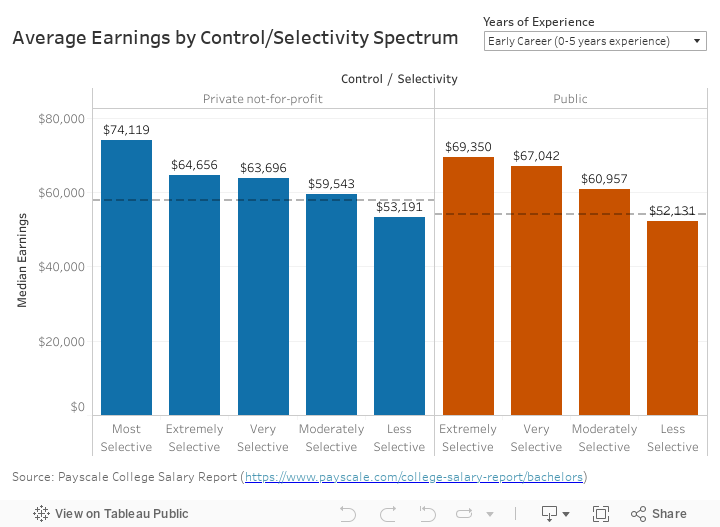
Our first visualization provides a striking overview of average early career earnings (0-5 years of experience) across the selectivity spectrum for both private and public institutions.
First, we find that the average private institution has a median early-career earnings of roughly $3,000 more than public institutions. However, if we compare public and private institutions within the same selectivity band, we find that earnings are roughly equal across sectors.
Across both private and public colleges, there鈥檚 a clear trend of higher selectivity correlating with higher early career earnings. This suggests that more selective institutions may provide advantages in terms of education quality, networking opportunities, or reputation that translate into higher initial salaries.
These earnings data provide a snapshot of post-graduation earnings, but to truly understand the value of a college education, we need to consider the investment that students make to obtain their degree and subsequent labor market outcomes. In the next section, we鈥檒l explore the return on investment by institution type.
Measuring College ROI: Beyond the Price Tag
While early career earnings provide valuable initial insights, our second visualization presents a more comprehensive picture by examining the average 20-year net ROI across the selectivity spectrum for both public and private institutions. In this context, ROI refers to the financial benefits of a degree relative to that institution鈥檚 cost of attendance, measured over a 20-year period after graduation and annualized.
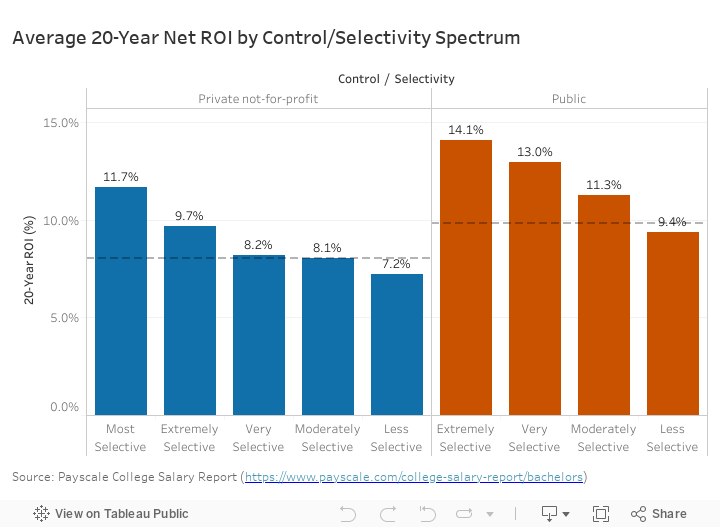
Despite private institutions having a slight edge in early and mid-career earnings, the average ROI of public institutions is much greater than the private sector (9.9% vs. 8.1%). This can largely be attributed to the lower cost of attendance at public institutions. While private institutions offer higher absolute earnings on average, the higher costs associated with these institutions often result in a lower net ROI over time.
Similar to our investigation of earnings, both public and private institutions demonstrate increasing ROI with increased selectivity, but this trend is more pronounced for public institutions.
Earnings vs. ROI: When Six Figures Don’t Tell the Whole Story
Our third visualization dives deeper into the relationship between earnings and ROI by plotting median mid-career earnings against 20-year ROI for both public and private institutions:
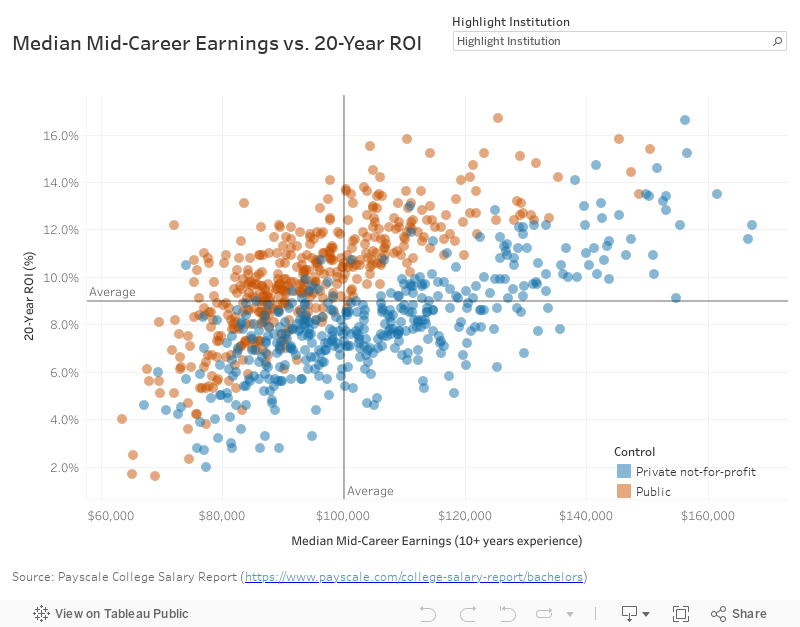
While it is not surprising that there is a strong positive correlation between mid-career earnings and 20-year ROI, some additional trends emerge. First, public institutions tend to cluster slightly higher on the ROI scale relative to their earnings, reinforcing our earlier observation about their potentially better value for the cost of education.
Second, there is high variation in ROI for institutions with similar mid-career earnings. For example, graduates of Oberlin College and the University of North Carolina at Chapel Hill have median earnings of roughly $104,000. However, the ROI of UNC Chapel Hill is 15.5% compared to Oberlin鈥檚 4.7%. This reiterates that factors beyond just earnings potential play a crucial role in determining the overall value of an education.
What Drives College Graduate Earnings?
We look at two measures that may help explain why some institutions offer higher earnings than others.
STEM Degrees and Salary Potential: Where Science Meets Salary
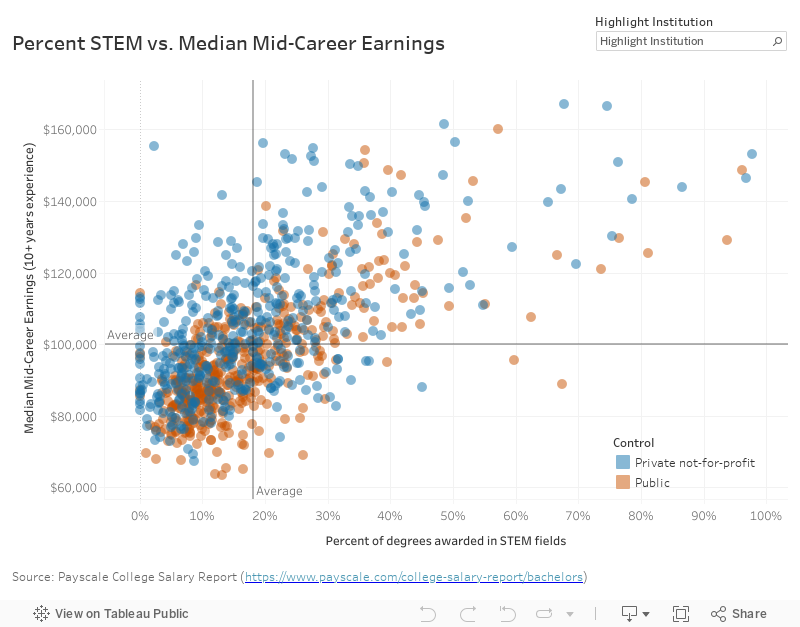
First, we find a clear positive correlation between the percentage of STEM degrees and median mid-career earnings: institutions with higher percentages of STEM degrees tend to have higher median mid-career earnings.
This correlation underscores the continued strong demand for STEM skills in the job market and the potential financial benefits of pursuing these fields. However, it’s important to consider that this data represents institutional averages and individual outcomes may vary significantly.
Pell Grants and Earnings: Exploring the Relationship
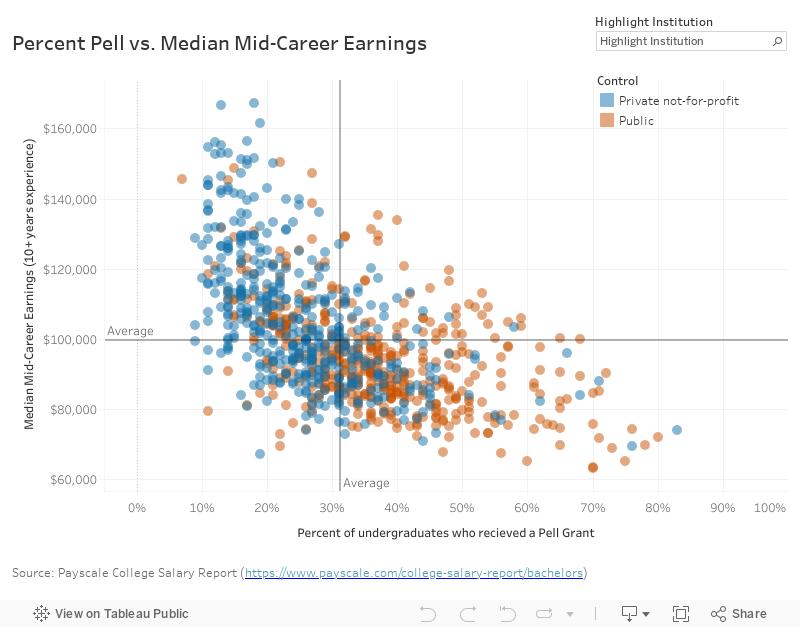
Looking into the sociodemographic determinants of institutional earnings outcomes, we find a generally negative correlation between the percentage of Pell Grant recipients and median mid-career earnings: as the percentage of Pell Grant recipients increases, median mid-career earnings tend to decrease. This correlation raises important questions about access to high-quality higher education outcomes and its long-term impact on earnings. However, it鈥檚 crucial to note that this relationship doesn’t imply causation; rather, it may reflect broader systemic issues related to access, resources, and career opportunities for students from economically disadvantaged backgrounds.
Conclusion: Maximizing Your College Investment
As we鈥檝e seen throughout this analysis, choosing the right college involves much more than simply looking at rankings or early career salaries. For students, parents, and counselors navigating the complex landscape of college admissions, five key takeaways emerge:
Look beyond initial earnings: While private institutions often show higher early-career salaries, public universities frequently offer better long-term ROI. This underscores the importance of considering the full financial picture, including tuition costs and potential student debt, when making your decision.
Consider your field of study: The strong correlation between STEM degrees and higher mid-career earnings highlights the financial benefits of these fields. However, it鈥檚 crucial to balance this with your personal interests and aptitudes.
Understand the impact of selectivity: More selective institutions generally correlate with higher earnings and ROI, but this benefit diminishes at the highest levels. This suggests that gaining admission to a 鈥済ood鈥� school is important, but the earnings differences between a 鈥渧ery good鈥� and an 鈥渆xcellent鈥� school may not be as significant as you might think.
Focus on value, not just prestige: The higher average ROI of public institutions challenges the notion that more expensive or prestigious schools always lead to better outcomes. Look for schools that offer a good balance of quality education, career preparation, and affordability.
Think long-term: While it鈥檚 natural to focus on starting salaries, our analysis shows the importance of considering long-term ROI. Think about how your college choice might affect your financial situation not just in the first few years after graduation, but decades down the line.
As you consider college options, we encourage you to look beyond simple rankings or average salaries. Consider factors such as cost of attendance, your intended field of study, and the specific programs and opportunities offered by each institution.
We encourage readers to explore the interactive visualizations provided to gain deeper insights into the patterns and trends in college outcomes. By adjusting the filters and examining different institutions, you can uncover valuable information about earnings outcomes post-graduation.
Ultimately, these visualizations offer a wealth of data to inform your understanding of the earnings outcomes in the higher education landscape. Use this information as one tool among many in making informed decisions about college choices and future career paths.
