In the competitive world of legal education, the journey to becoming a lawyer often begins long before the first day of law school. But just how much does your choice of undergraduate institution influence your chances of donning that J.D. cap and gown? While LSAT scores and GPAs undoubtedly play crucial roles, the influence of one鈥檚 undergraduate institution on this path is a subject of intense interest for students, parents, and educators alike. In this second installment of our 鈥渇eeders鈥� series, we look into the data to uncover the interaction between undergraduate institutions and law schools.
Our analysis draws from a rich dataset of over college graduates since 2005 collected from LinkedIn, offering a comprehensive view of educational and career trajectories across the United States. This wealth of data allows us to paint a detailed picture of the pathways that lead from college dorms to law school lecture halls.
Ivy League Dominance or a More Diverse Picture?
At first glance, our data seems to confirm what many might expect – prestigious universities appear to have a stronghold on top attendance into the top law schools in the country.
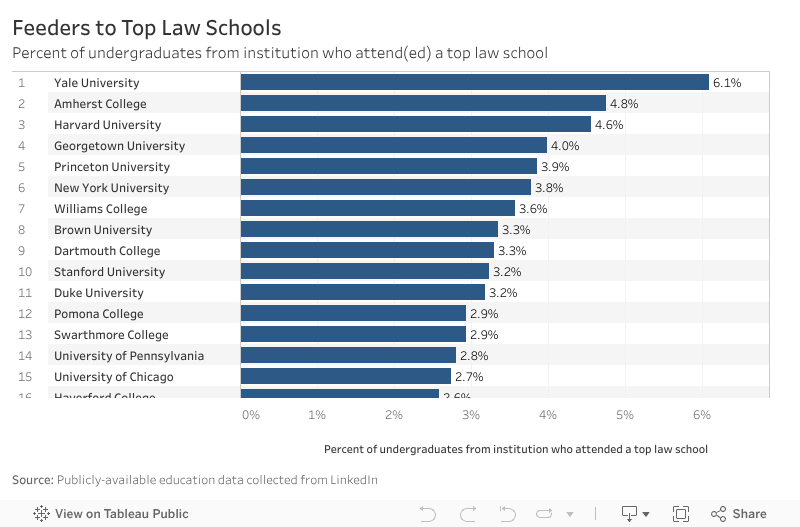
Note: For the purposes of this analysis, we consider the following as top law schools: Yale University, Stanford University, Harvard University, Columbia University, University of Chicago, New York University, University of Pennsylvania, University of Virginia, Northwestern University, University of California Berkeley, University of Michigan, Duke University, Cornell University, and Georgetown University.
Yale University stands tall, sending a whopping 6.1% of its graduates to top law schools. Amherst, Harvard and Georgetown follow closely behind. However, the picture becomes more nuanced when we look at law school attendance rates for any law school, not just the top ones:
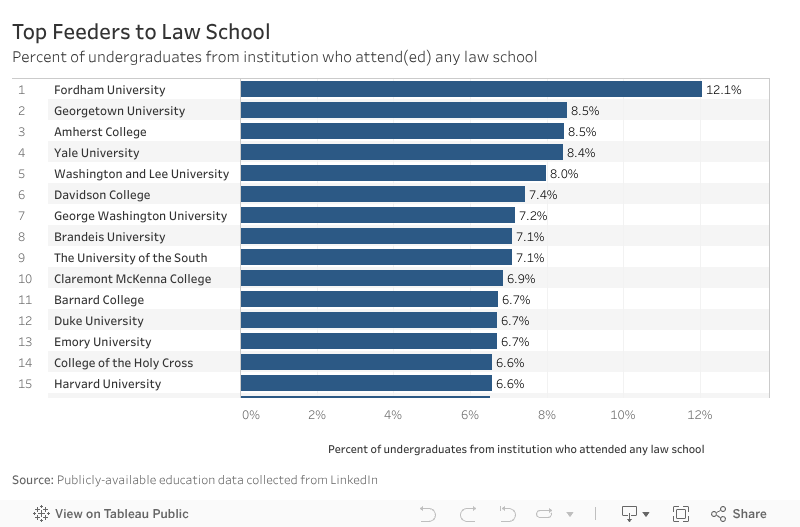
Fordham University takes the crown on this metric, with 12.1% of its graduates pursuing law degrees. This revelation challenges the notion that only the most elite universities pave the way to legal careers. It suggests that factors like strong pre-law programs, dedicated career services, and perhaps even location play crucial roles in steering students towards law school.
Looking closely at liberal arts colleges among these rankings, we see some impressive performers. Amherst College, Washington and Lee, and Davidson college each emerge as powerhouses, sending many of its graduates to law schools. Sewanee isn鈥檛 far behind. This data hints at a secret weapon in the liberal arts arsenal – perhaps the emphasis on critical thinking, writing, and interdisciplinary study gives these students an edge in law school applications.
Public Powerhouses
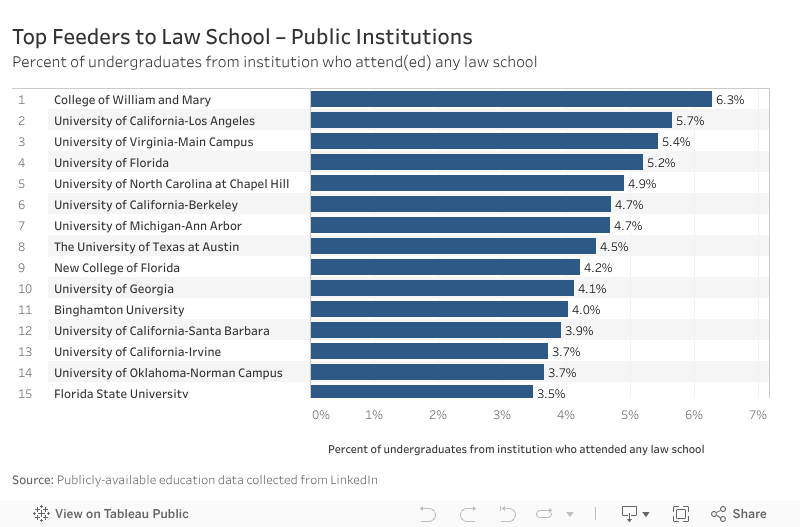
When we focus on Public colleges, William & Mary leads the pack, with UC schools also making a strong showing. This underscores an important point – public universities offer robust pathways to legal careers, often at a fraction of the cost of private institutions.
The Selectivity Spectrum
Let’s step back and look at the bigger picture. How does undergraduate selectivity correlate with law school attendance?
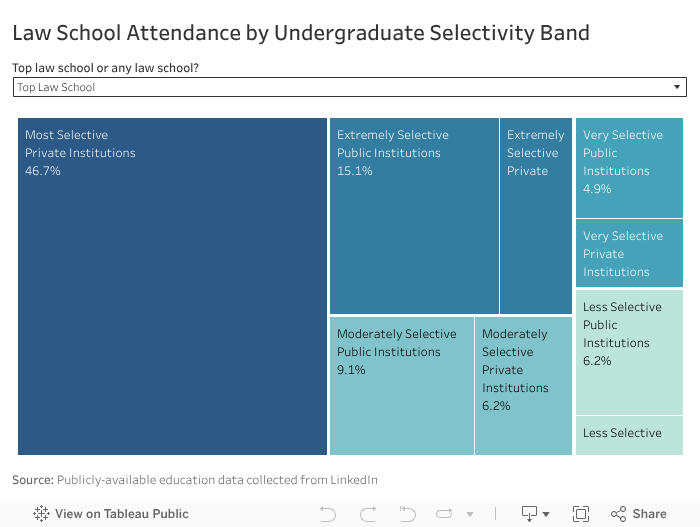
The most selective private institutions account for nearly half of all students attending top law schools. But don’t despair if you’re not headed to an uber-selective private college. Extremely selective public institutions also make a strong showing, suggesting that flagship state universities can also be excellent launchpads for legal careers.
When we expand the view to look at all law schools, lesser-selective institutions take up a bigger share. This suggests that pathways to a law degree are possible even if you don’t attend a top-ranked undergraduate institution.
Following the Pipelines
To really understand these trends, we can look at specific institutional pathways. This visualization allows us to explore where students from a selected undergraduate institution end up attending law school. Let’s take Amherst College as an example:
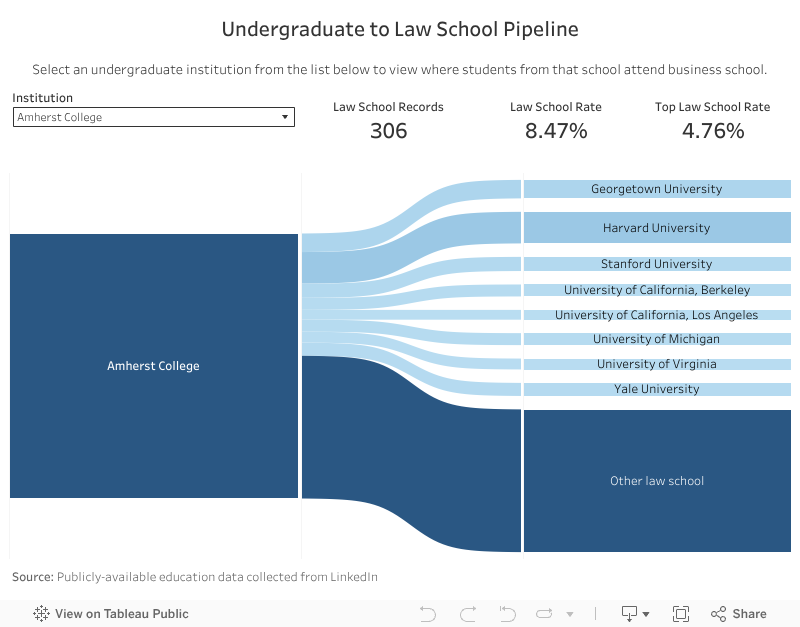
Amherst graduates spread their wings, landing at a diverse array of top law schools. Feel free to select a college of your choice to view where students from that institution end up attending law school.
Flipping the Script: The Law School Perspective
Now, let’s look at things from the other side. Where do top law schools draw their students from?
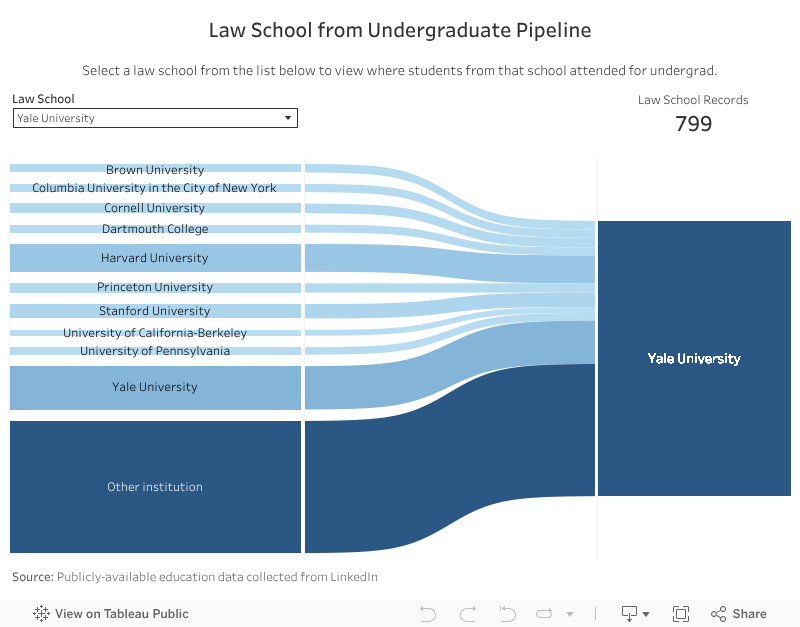
Yale Law School, often considered the pinnacle of legal education, shows a clear preference for Ivy League and other elite institutions. But note the 鈥淥ther institution鈥� category – it’s a reminder that there鈥檚 always room for exceptional candidates from a wide range of backgrounds.
So, What’s the Verdict?
After sifting through this data, what can we conclude? Here鈥檚 the takeaway: while attending a prestigious, selective undergraduate institution can give you a leg up in law school admissions, it’s far from the only path to a legal career.
Strong liberal arts programs, well-regarded public universities, and institutions with robust pre-law support all offer viable routes to law school. Your undergraduate choice matters, but it’s not destiny. Factors like your GPA, LSAT score, extracurriculars, and personal statement play crucial roles in shaping your law school journey.
The key is to choose an undergraduate institution that will challenge you, help you develop critical thinking and writing skills, and provide opportunities for personal growth. Whether that’s an Ivy League university, a small liberal arts college, or a flagship state school depends on your individual needs and goals.
Remember, the path to law school is as diverse as the law itself. So explore these visualizations, dig into the data, and chart the course that’s right for you. After all, the best predictor of your success in law school – and beyond – is not the name on your undergraduate diploma, but your passion, dedication, and hard work.
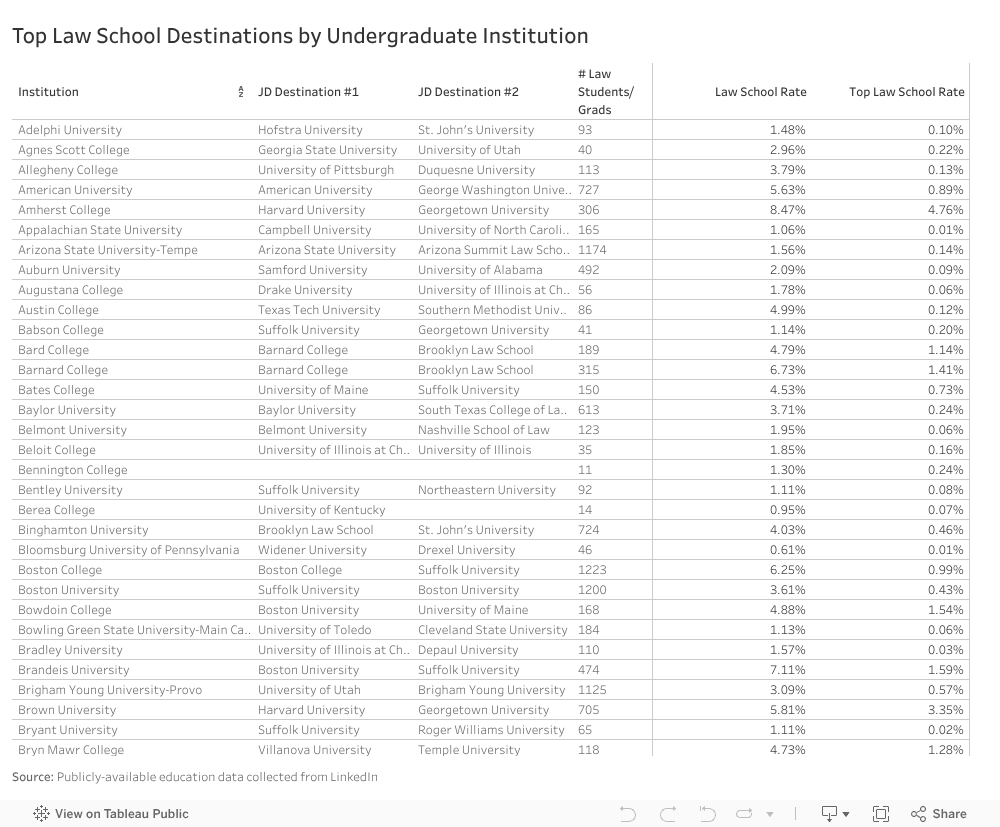
We encourage readers to dive into the interactive visualizations provided to gain deeper insights into the patterns and trends in law school admissions pipelines. By examining different institutions, you can uncover valuable information about specific pathways to J.D. degrees. For those interested in a more detailed breakdown of the data, we’ve included a comprehensive table below, allowing for easy comparison across institutions and offering a wealth of information for aspiring law students, parents, and pre-law advisors alike. However, it’s important to note a key limitation of this data: it only includes students who matriculated to law schools, not those who were accepted but chose not to attend. This means we’re seeing the end result of a complex decision-making process, not just admissions outcomes.
Whether you’re interested in the broader trends of law school feeders or the specific pathways from particular undergraduate institutions, these visualizations offer a rich dataset to inform your understanding of the legal education landscape. Explore how factors such as undergraduate selectivity, liberal arts focus, or public vs. private status influence law school admissions, and discover which institutions have the strongest pipelines to top-tier law programs.