

Investment banking continues to be one of the most sought-after career paths for ambitious college graduates, offering exceptional compensation packages and accelerated professional development opportunities. Entry-level investment banking analysts at top firms typically receive total compensation exceeding $150,000, including base salary and bonuses. Through analysis of LinkedIn data from recent graduates (2015-onwards) at 16 leading financial institutions, we’ve uncovered compelling patterns in recruitment and institutional pipelines that provide valuable insights for aspiring investment bankers and their advisors.
Methodology:
Our analysis examines employment data from LinkedIn, focusing specifically on entry-level investment banking positions. To ensure data accuracy and relevance, we applied the following criteria:
- Employment Scope: Analysis limited to U.S.-based employees working at 16 identified financial institutions: Goldman Sachs, Citi, J.P. Morgan, Bank of America, Bank of America Merrill Lynch, UBS, Morgan Stanley, Credit Suisse, Barclays, Evercore, Greenhill & Co., Jefferies, Lazard, Moelis, Centerview, or Perella
- Position Requirements: Only employees with current job titles of: Investment Banking Analyst or Investment Banking Summer Analyst
- Time Frame: Graduates from 2015-onwards with fewer than 5 years of experience
Key Findings and Analysis:
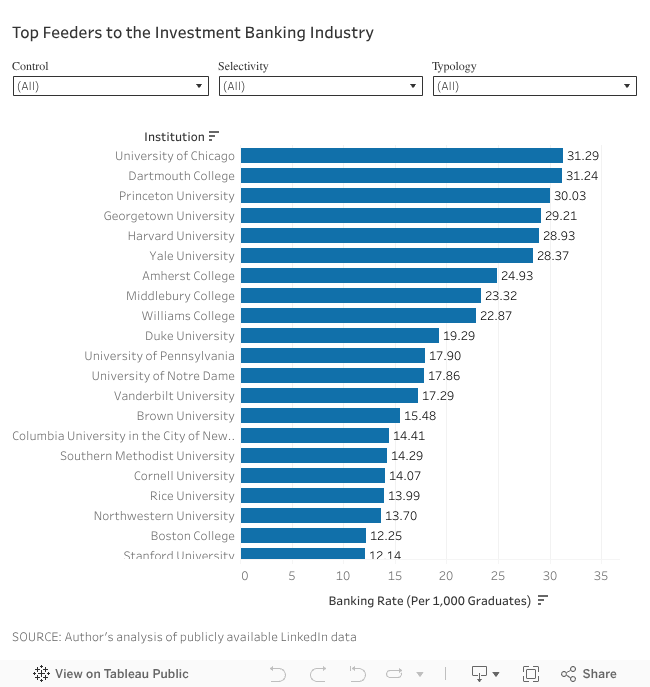
The University of Chicago leads investment banking placement rates with approximately 31.29 analysts per 1,000 graduates, followed closely by Dartmouth College (31.24) and Princeton University (30.03). This concentration at elite institutions reflects the industry’s emphasis on rigorous quantitative training and structured analytical thinking.
Investment banks traditionally recruit heavily from institutions with strong economics, mathematics, and business programs. The University of Chicago’s leading position can be attributed partially to its renowned economics department and the Booth School of Business’s influence on undergraduate education. Similarly, Georgetown’s McDonough School of Business and Notre Dame’s Mendoza College of Business have developed robust pipelines to Wall Street through specialized undergraduate finance curricula.
Liberal Arts Excellence in Finance
A notable trend emerges in the strong performance of elite liberal arts colleges, with Amherst, Middlebury, and Williams all placing among the top feeders. These institutions’ success challenges the notion that a business-specific degree is necessary for investment banking careers. Their graduates’ strong analytical and communication skills, coupled with rigorous quantitative training, appear highly valued by financial institutions.
The Selectivity Factor
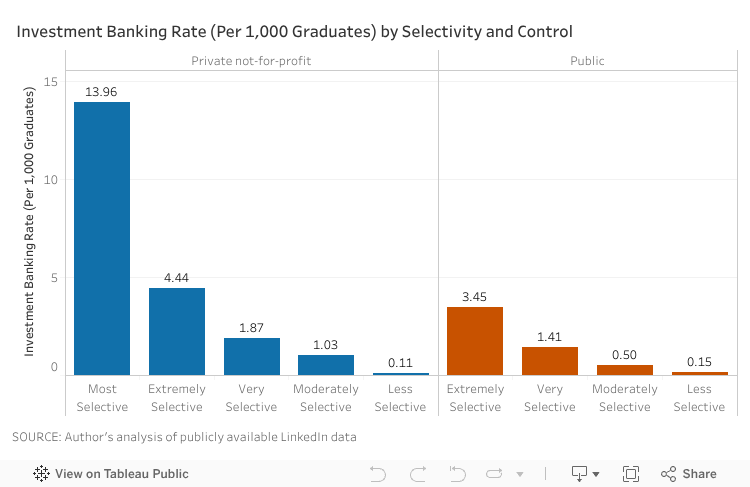
Among private not-for-profit institutions, the most selective schools demonstrate a remarkable placement rate of 13.96 analysts per 1,000 graduates, significantly higher than other selectivity tiers. This pattern suggests that investment banks place considerable emphasis on academic achievement and institutional prestige in their recruitment processes.
Implications:
Students aspiring to investment banking careers should focus on developing strong quantitative skills through coursework in mathematics, economics, and statistics, as well as financial modeling capabilities through specialized courses or self-study. Additionally, an understanding of accounting principles and financial statement analysis, programming skills (particularly in Excel and Python), and clear written and verbal communication abilities are essential.
Early engagement in the investment banking field is key, as the summer analyst recruitment cycle can begin as early as sophomore year. Students should engage with career services and finance clubs from the very start of their undergraduate careers.
Additionally, technical preparation beyond coursework is essential for success. Students should seek out opportunities to develop their skills through financial modeling certifications, programs such as Wall Street Prep, Bloomberg Terminal certification, and participation in investment clubs.
Lastly, networking development can be crucial in securing a coveted position. Successful candidates often leverage their alumni networks in finance, attend industry information sessions, participate in finance-focused student organizations, and utilize LinkedIn for professional connections.
Conclusion:
While the path to investment banking careers shows a clear advantage for students at highly selective institutions, success requires a combination of strategic academic preparation, technical skill development, and professional networking. Students should focus on developing both quantitative and qualitative skills while building their professional networks early in their academic careers.
For students and counselors seeking more information about investment banking careers, we recommend exploring:
- Major investment banks’ career pages for recruitment timelines and requirements
- Professional certifications in financial modeling and analysis
- Campus career services offices for institution-specific recruitment data
- Wall Street Oasis and similar forums for industry insights

