

The technology industry continues to offer some of the most compelling career opportunities for ambitious college graduates. Entry-level software engineers at leading tech companies typically command base salaries exceeding $120,000, with total compensation packages often reaching $180,000+ when including stock grants and bonuses. Beyond compensation, the industry offers unprecedented opportunities for impact, with even junior engineers shipping code used by millions of users within their first year.
Through analysis of LinkedIn data from recent graduates (2015-onwards) entering engineering roles across the technology sector, we’ve uncovered distinct patterns in recruitment and institutional pipelines that provide valuable insights for aspiring technologists and their advisors.
Methodology
Our analysis examines employment data from LinkedIn, focusing specifically on engineering positions in the technology sector. To ensure data accuracy and relevance, we applied the following criteria:
- Position Requirements: Employees were classified as tech workers through either:
- A combination of job title containing “software” AND (“engineer” OR “developer”), engineering job role, and qualifying industry (internet, computer software, consumer electronics, computer networking, information technology and services, or computer hardware)
- OR employment in an engineering role at one of 15 identified top tech companies including Microsoft, Google, Apple, Amazon, Meta, Salesforce, Nvidia, Adobe, Cisco, LinkedIn, Intuit, HubSpot, Spotify, Netflix, and DocuSign
- Time Frame: Graduates from 2015-onwards with fewer than 5 years of experience
Key Findings and Analysis
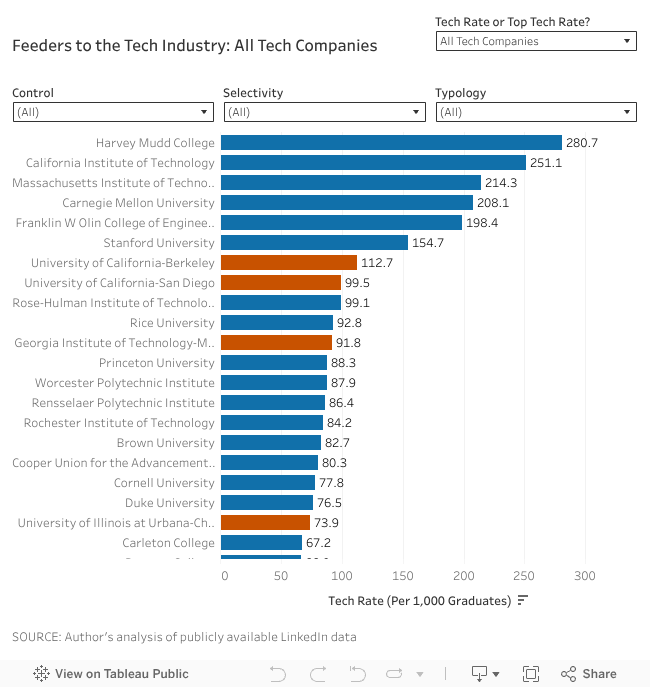
The data reveals Harvey Mudd College leads all institutions with approximately 280.7 tech workers per 1,000 graduates when considering the broader technology sector, followed by Caltech (251.1) and MIT (214.3). This dominance of specialized technical institutions reflects the industry’s emphasis on deep computational expertise and practical engineering skills.
Harvey Mudd’s exceptional performance can be attributed to its innovative computer science curriculum, which emphasizes both theoretical foundations and practical software engineering through its renowned Clinic Program. Similarly, Caltech’s Computing and Mathematical Sciences department has developed a robust pipeline to Silicon Valley through its focus on algorithmic thinking and fundamental computer science principles.
The Research University Advantage
Elite research universities show particularly strong placement rates, with Carnegie Mellon University (208.1 per 1,000) and Stanford University (154.7 per 1,000) leading this category. Carnegie Mellon’s School of Computer Science, consistently ranked among the world’s best, has developed deep relationships with technology employers through its pioneering research in artificial intelligence and software engineering. Stanford’s proximity to Silicon Valley, combined with its entrepreneurial culture and strong computer science program, creates natural pathways into the technology sector.
When focusing specifically on placement at top 16 tech companies, the patterns remain similar but with lower absolute rates, reflecting the heightened selectivity of these employers. Harvey Mudd still leads with 159.8 placements per 1,000 graduates, followed by Caltech (136.8) and Carnegie Mellon (119.3). This consistency suggests that the factors driving overall tech placement – strong technical education, practical engineering experience, and robust industry connections – are particularly valued by leading technology employers.
Public Institution Success Stories
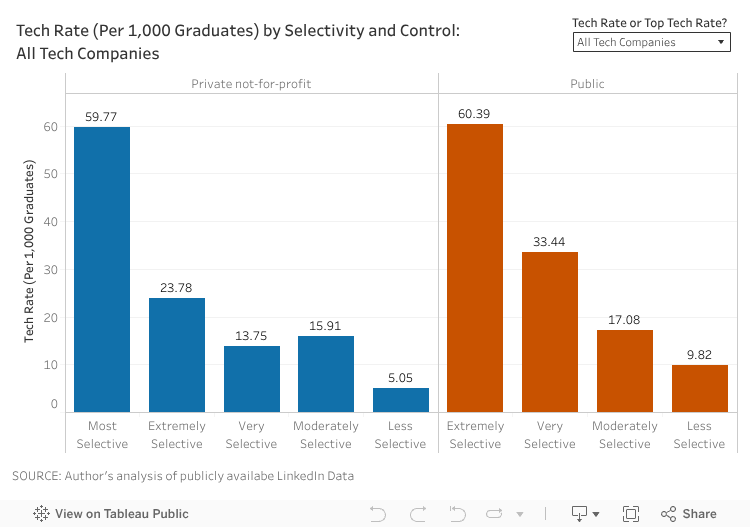
Our analysis reveals compelling patterns in how institutional characteristics influence technology industry placement rates. Among private not-for-profit institutions, the most selective schools demonstrate exceptional success, with approximately 59.77 engineers per 1,000 graduates entering the technology sector. This rate declines steadily across selectivity tiers, with extremely selective institutions placing 23.78 per 1,000 graduates and less selective institutions placing just 5.05 per 1,000.
Public institutions, particularly within the University of California system, show remarkable performance at the highest selectivity tiers. UC Berkeley leads public institutions with 112.7 placements per 1,000 graduates, followed closely by UC San Diego at 99.5 per 1,000. These numbers contribute to an impressive 60.39 per 1,000 placement rate for extremely selective public institutions overall. Berkeley’s Electrical Engineering and Computer Sciences (EECS) department, one of the oldest and most prestigious in the country, has built robust recruiting relationships with both established tech companies and startups. This pattern holds true even when examining placements specifically at top technology companies, where extremely selective public institutions achieve 27.12 placements per 1,000 graduates, nearly matching the 30.27 rate of their most selective private counterparts.
These findings suggest that while institutional selectivity strongly correlates with technology career outcomes, geographic proximity to tech hubs and strong engineering programs can help public institutions overcome any presumed advantages of private institution status. The success of the UC system demonstrates that public universities can provide equally robust pathways into both the broader technology sector and its most prestigious employers.
Implications for Students
The data underscores several key considerations for students aspiring to tech careers:
- Strong computer science fundamentals remain crucial, with institutions emphasizing theoretical foundations and practical engineering showing the highest placement rates.
- Geographic proximity to tech hubs can provide significant advantages through increased internship opportunities and recruiting relationships.
- Public institutions, particularly those with strong engineering programs, can provide equally viable pathways into both the broader tech sector and top tech companies.
- Early technical preparation is essential, as successful candidates often begin building their programming skills and project portfolios well before graduation.
Conclusion
While the path to tech careers shows clear advantages for students at specialized technical institutions, success stories emerge from a broad range of schools. The key for students and counselors is understanding these patterns while recognizing that individual technical preparation and project experience often matter more than institutional prestige.
For students and counselors seeking more information about tech careers, we recommend exploring:
- Individual company technical blog posts and engineering documentation
- Campus career services offices for institution-specific recruitment data
- Professional organizations focused on software engineering and computer science
- GitHub profiles and technical blogs of current engineers at target companies
- Online coding platforms and open-source projects for practical experience

