As we continue our exploration of educational pathways, we turn our attention to the world of business education. In this third installment of our 鈥渇eeders鈥� series, we explore the pathways from undergraduate institutions to business schools. While GMAT scores and work experience are undoubtedly crucial factors in MBA admissions, the role of one鈥檚 alma mater in shaping this journey remains a topic of fascination for students, parents, and educators alike. Drawing from our extensive dataset of over 7.7 million college graduates since 2005, sourced from LinkedIn profiles, we’ve uncovered some intriguing patterns in the business school pipeline. Let’s dive into the data and see what stories it tells.
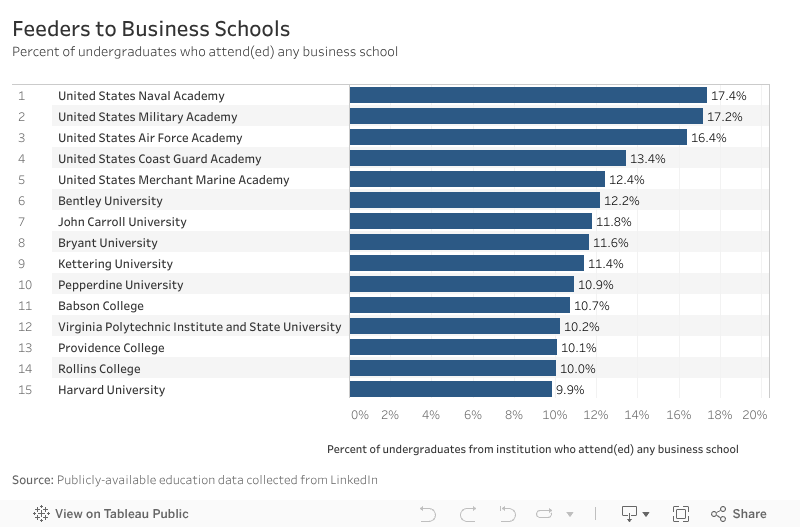
Perhaps surprisingly, we find that military academies dominate the list of institutions sending the highest percentage of their graduates to business schools. The United States Naval Academy leads the charge, with an impressive 17.4% of its alumni pursuing MBA degrees. The United States Military Academy (17.2%) and the United States Air Force Academy (16.4%) follow closely behind. This trend suggests that military education provides a robust foundation for business leadership, potentially due to its emphasis on discipline, strategic thinking, and organizational management.
Following the military academies, we see strong performance from institutions with a business focus. Bentley University (12.2%), Bryant University (11.6%), and Babson College (10.7%) all send a significant proportion of their graduates to business schools. This data indicates that these specialized programs may offer particularly effective preparation for MBA studies.
The Ivy League Effect: Dominating Top MBA Programs
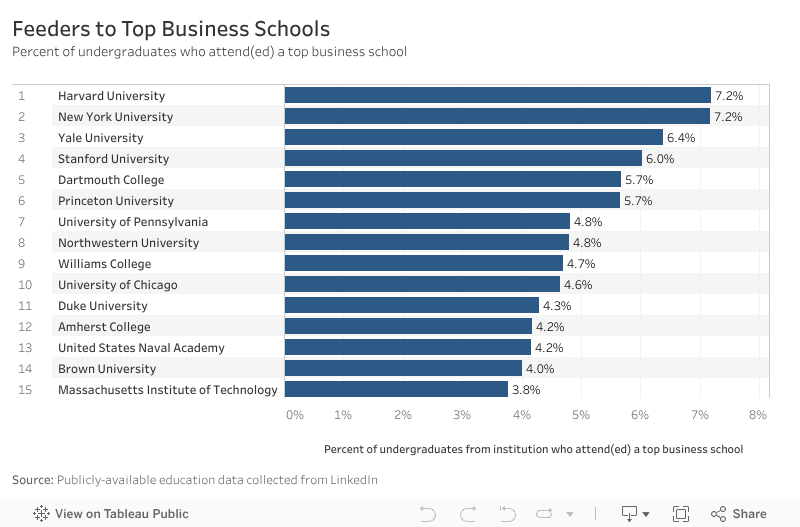
When we narrow our focus to attendance at top-tier business schools, the landscape shifts dramatically. Harvard University and New York University share the top spot, each sending 7.2% of their graduates to elite MBA programs. Yale University (6.4%) and Stanford University (6.0%) follow closely behind. This data echoes what we saw in our law school and medical school analyses 鈥� while prestigious universities may not lead in overall graduate school attendance, they have a stronghold on pathways to the most competitive programs.
The Selectivity Spectrum
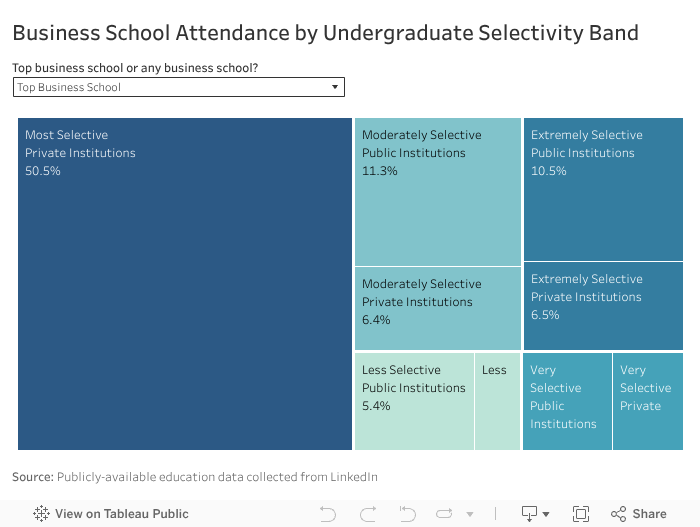
Zooming out to look at the bigger picture, we find that the most selective private institutions account for over half (50.5%) of all students attending top business schools. However, extremely selective public institutions also make a strong showing at 10.5%. This suggests that flagship state universities can serve as excellent launchpads for business careers, offering a potential alternative to the often more expensive private school route. When we expand our view to include all business schools, we see a more diverse picture. Less selective institutions claim a larger share, indicating that there are many viable pathways to graduate-level business education beyond the most elite undergraduate programs.
Following the MBA Pipelines
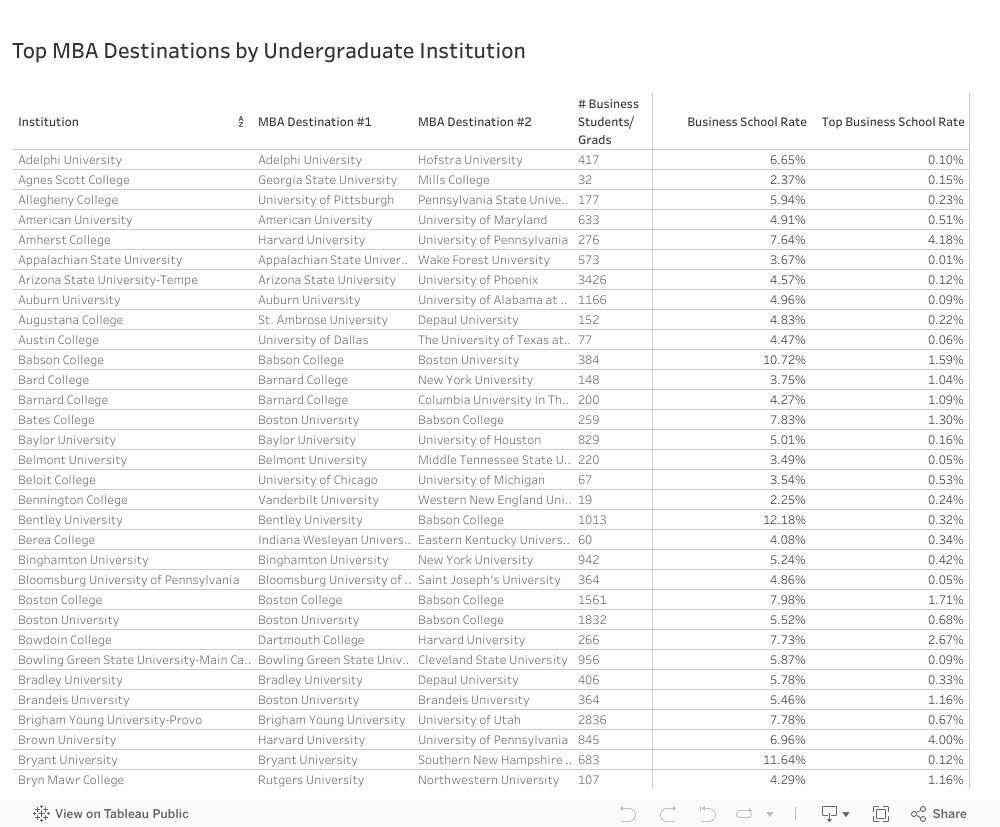
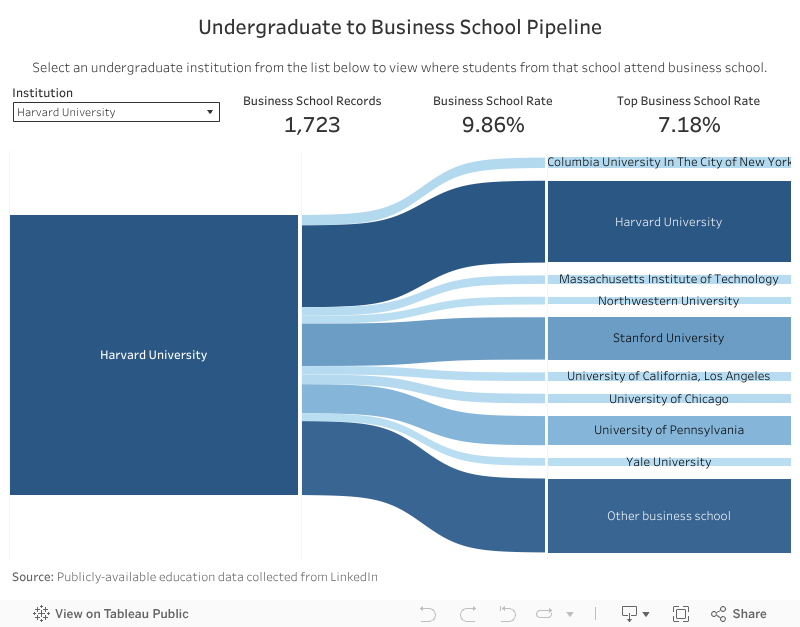
To truly understand these trends, it鈥檚 helpful to examine specific institutional pathways. Taking Harvard University as an example, we see that while many of its graduates attend Harvard Business School, there’s also significant representation at other top programs like Columbia, Stanford, and MIT:
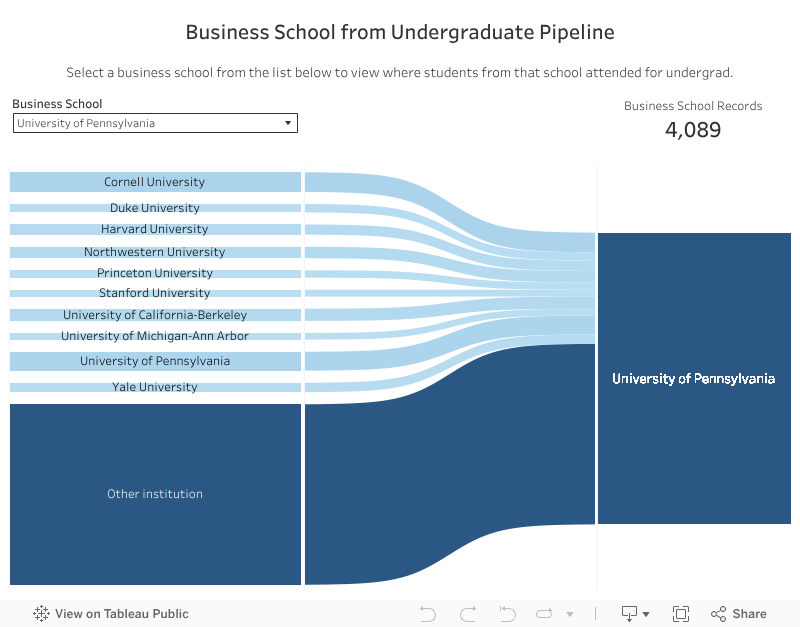
Flipping the perspective, when we look at where top business schools draw their students from, we see a varied landscape. The University of Pennsylvania鈥檚 Wharton School, for instance, attracts students from a wide range of elite institutions but also maintains a strong pipeline from its own undergraduate program. However, it鈥檚 important to note that 61.9% of Wharton MBA attendees attend other undergraduate institutions. That said, the path to Wharton is certainly possible without a top-tier undergraduate diploma.
Charting Your Course to Business School
What can we conclude from this data? While attending a prestigious undergraduate institution can certainly open doors to top MBA programs, it鈥檚 far from the only path to a graduate business education. Military academies, specialized business programs, and well-regarded public universities all offer viable routes to business school. Your undergraduate choice matters, but it鈥檚 not destiny. Factors like your GPA, GMAT score, work experience, and personal statement play crucial roles in shaping your business school journey.
The key is to choose an undergraduate institution that will challenge you, help you develop critical thinking and leadership skills, and provide opportunities for personal growth. Whether that鈥檚 an Ivy League university, a military academy, or a specialized business school depends on your individual needs and goals.
Remember, the path to business school is as diverse as the business world itself. So explore these visualizations, dig into the data, and chart the course that鈥檚 right for you. After all, the best predictor of your success in business school 鈥� and beyond 鈥� is not the name on your undergraduate diploma, but your passion, dedication, and hard work.
We encourage readers to dive into the interactive visualizations provided to gain deeper insights into the patterns and trends in business school admissions pipelines. By examining different institutions, you can uncover valuable information about specific pathways to MBA degrees.
For those interested in a more detailed breakdown of the data, we’ve included a comprehensive table below, allowing for easy comparison across institutions and offering a wealth of information for aspiring business leaders, parents, and advisors alike.
As we conclude this third installment in our “feeders” series, we’re reminded of the complex and multifaceted nature of graduate school admissions. Whether you’re considering law school, medical school, or business school, the data reveals both common threads and unique patterns in each field. We hope this series has provided valuable insights to inform your educational journey, whatever path you choose to pursue.